
From energy-saving programmes to telemetry and recycled steel, Evoca Group considers efficiency, materials and resource use throughout a coffee machine’s lifecycle. The professional coffee equipment group’s UK Managing Director, Andrew Barrow, and Chief Sustainability Officer, Giusi Bonini, tell World Coffee Portal how stronger environmental performance and lower cost of ownership can reinforce each other
Sustainability has become an important purchasing and operational consideration for coffee operators. Rising energy costs, detailed tender requirements and growing regulation of environmental claims mean that the equipment behind the counter is under more scrutiny than ever before.
Evoca Group, the business behind Necta, Gaggia Milano and Saeco Professional, has spent decades refining how its machines perform over their full working life. In the UK alone, the company dispatches around 4,500 machines a year and holds between 14,000 and 15,000 individual spare parts, supporting everything from floor-standing vending units to automatic bean-to-cup and traditional espresso machines.
“Twenty years ago, coffee equipment sustainability was nowhere,” says Andrew Barrow, Managing Director, Evoca UK. “Now people are very interested in what we’re doing, how we’re driving forward, and how we’re leading the way.”
A systematic approach
When Giusi Bonini, an engineer with three decades in the coffee industry, took responsibility for Evoca’s sustainability programme in 2021, she saw an opportunity to build a structured, verifiable approach encompassing products, operations and the wider value chain.
“Sustainability is a system, exactly like the other systems already present in a company,” she says. “A system means policies, programmes and KPIs. It’s a very engineered, structured way to tackle the different aspects. And at the heart of all of this are our products.”
That system is built on longstanding commitments. Evoca has held ISO 14001 environmental certification since 1997 and quality certification since 1994. The company has also committed to the Science Based Targets initiative (SBTi), aligning its emissions reduction with the 1.5°C goal of the Paris Agreement.
One of Bonini’s first priorities was to develop an internal Product Carbon Footprint Tool, tailored to Evoca’s products and aligned with recognised standards such as ISO 14067. “You can’t improve what you can’t measure,” she says.
By far the largest share of emissions are generated from the ‘use phase’ – the years a machine spends in service – driven predominantly by energy consumption. Materials are the second-largest contributor, and manufacturing, largely the assembly process, accounts for a smaller share.
To bring manufacturing emissions down, Evoca’s manufacturing operations source 100% renewable electricity.
“Sustainability and economic performance are not antagonists,” says Bonini. “Very often they reinforce each other. In a coffee machine, the major share of the environmental footprint is energy consumption, so reducing energy consumption addresses both emissions and operating costs.”
Evoca frames this dynamic through total cost of ownership (TCO), which looks beyond the initial purchase price to assess every cost throughout a machine’s life, including energy and water use, cleaning cycles, service, spare parts and downtime. All Evoca machines also feature energy-saving functions, and for large estates the cost savings quickly add up – especially amid rising energy prices across Europe.
“For a big organisation with 500 to 1,000 machines, even saving £1 ($1.30) a day per machine makes a big difference over the course of a year,” says Barrow.
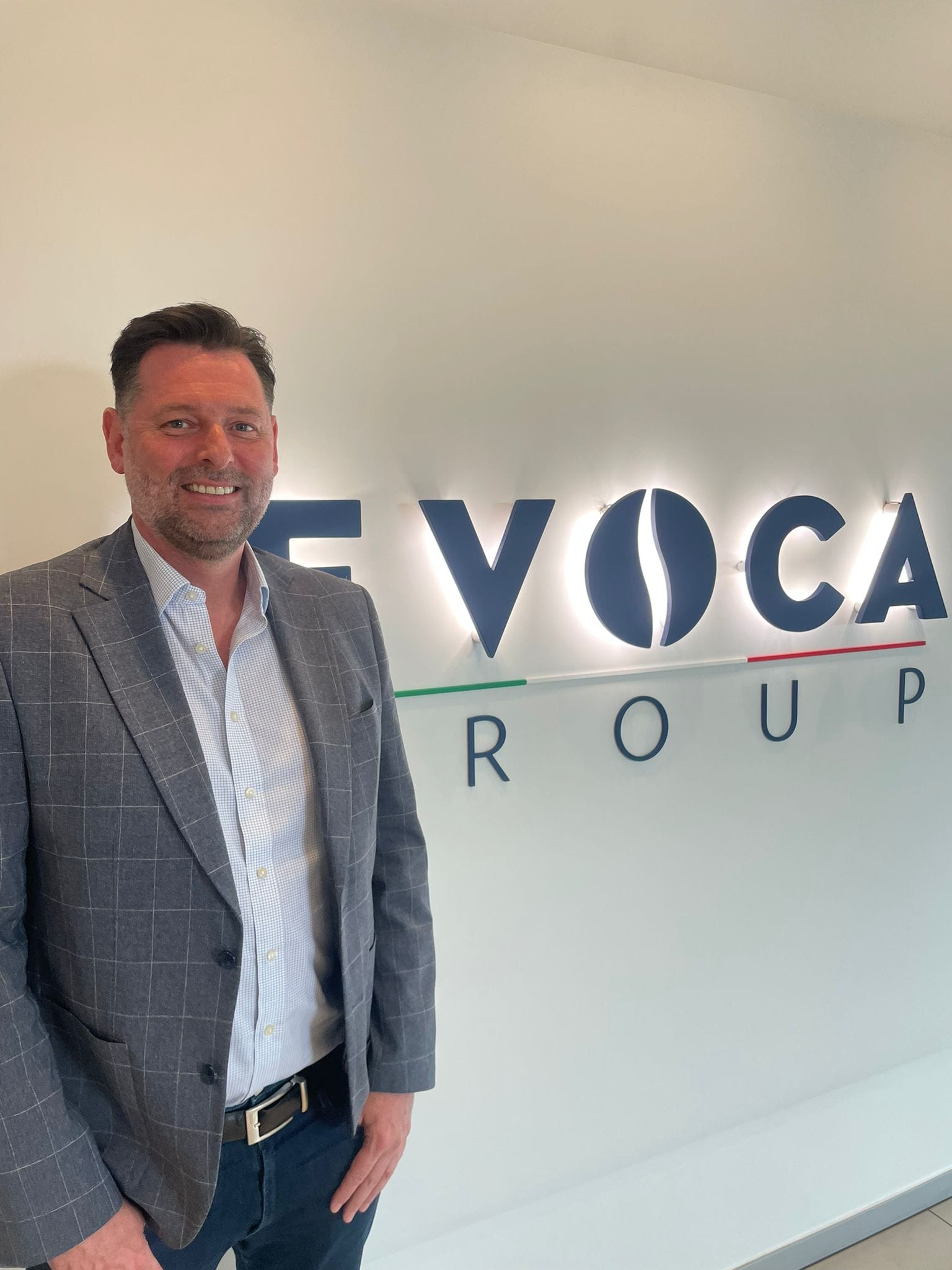

Evoca Group’s UK Managing Director Andrew Barrow (left) and Chief Sustainability Officer Giusi Bonini (right) | Photo: Evoca Group
Equipment longevity is another crucial cost concern. Evoca’s Necta vending machines can remain in service for more than 20 years, while high-throughput bean-to-cup machines typically last around seven years and traditional espresso machines around ten. Within the market, older machines are often refurbished and redeployed in lower-volume settings, extending their useful life.
Evoca also offers renewed spare parts as an alternative to new original equipment manufacturer (OEM) parts, which reduces cost and the need for new raw materials. Through its Newlife programme, Evoca offers selected original parts recovered from end-of-life machines. These are inspected, serviced and tested before being made available again, offering an alternative to newly manufactured parts and helping to retain the value of existing components.
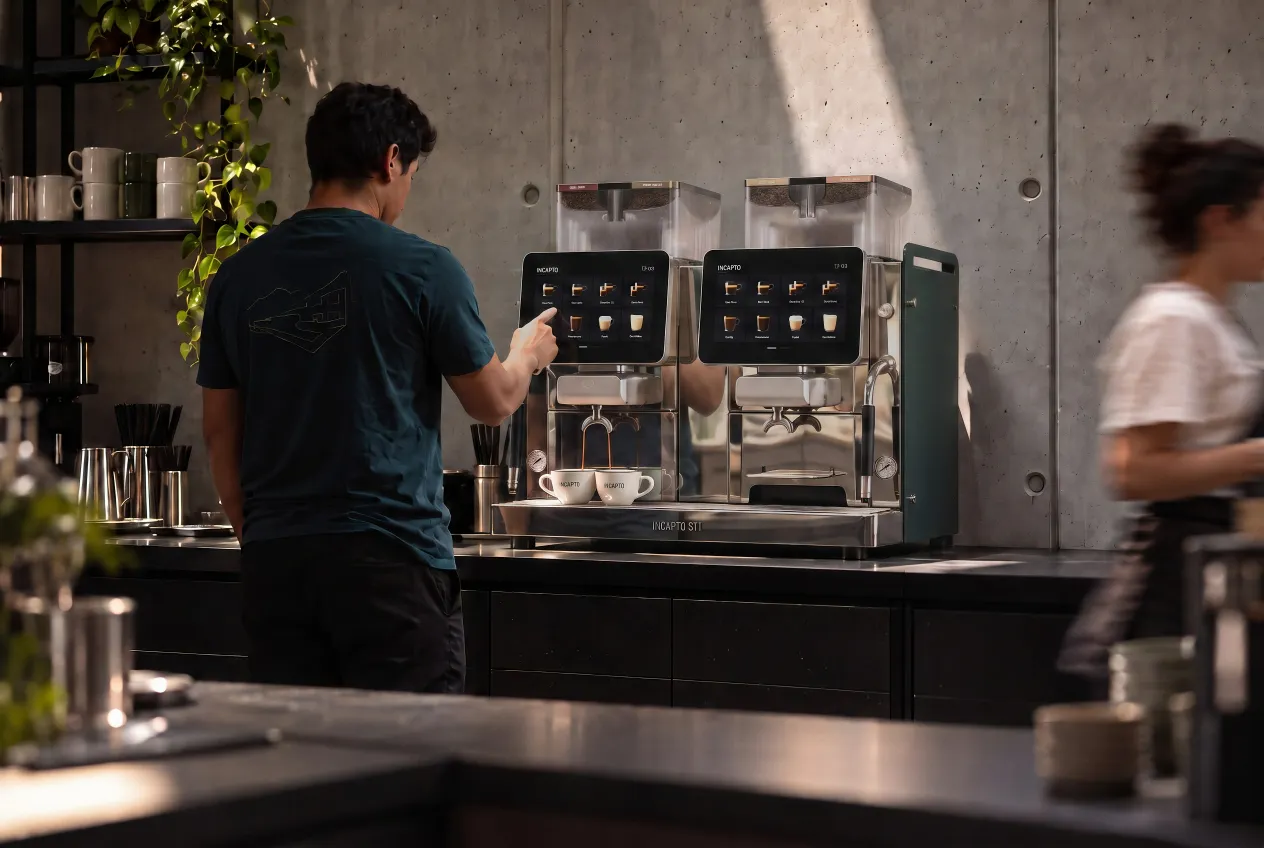
The Gaggia G Line, a range of automatic bean-to-cup machines from the G 50 to the G 700, demonstrates these principles in practice.
Recommended output ranges from around 50 drinks a day on the G 50 to 250 and up to 300 on the G 700, with the same espresso quality across the range.
“With the G Line, sustainability was treated as part of product performance, written into the specifications from day one,” says Bonini. “Energy consumption is a performance. The materials used are a performance. Whether the machine is easy to maintain is a performance.”
Around 75% of parts are common across the range, meaning engineers carry fewer spares, vans are lighter, and fuel use falls. Steel parts contain 35% recycled steel, and the machines are designed to be easily dismantled, with glued components kept to a minimum to facilitate disassembly, material separation and recovery at end of life.
Fixing faults remotely
Evoca’s digital tools are now so advanced that maintenance can often be conducted without the need for a site visit. Through telemetry, customers can connect remotely to a machine, diagnose problems, adjust settings and deliver software updates.
“They can dial in within 15 minutes,” says Barrow. “They’re never going to get someone on site within 15 minutes; it might be a day. So we’re seeing huge benefits from a sustainability perspective and a customer satisfaction perspective.”
Where a site visit is needed, machine data helps to identify the likely fault in advance, so the nearest engineer with the right part can be dispatched the first time, cutting both downtime and unnecessary journeys.
For the next generation of coffee professionals
Evoca is constantly assessing its sustainability strategy to improve its effectiveness, and both Bonini and Barrow see significant room for further progress. Heating water remains the biggest energy cost, and Barrow expects more efficient technologies, such as induction heating, to find their way into coffee equipment.
He also points to automated cleaning programmes that could prevent failed cycles and the extra water they consume, while AI-driven calibration could keep machines running at peak efficiency.
For Bonini, the next step is equipment that understands itself. “Machines will incorporate the capability to measure their own performance,” she says. “Once you can measure where you are, you can really optimise and minimise energy and resource use.”
For hospitality operators, the result is equipment that costs less to run, stays in service for longer and stands up to the growing demand for sustainability claims backed by evidence.
Discover how Evoca Group’s Necta, Gaggia Milano and Saeco Professional equipment can support lower total cost of ownership, efficient resource use and long-term performance – visit evocagroup.com/en/sustainability