

A brilliant plan to end commodity-linked deforestation or a costly burden for businesses? Love it or hate it, more than five years after being proposed, EUDR is still stuck in the starting blocks. Tobias Pearce spoke with Jon Trask, CEO of Dimitra, to find out why
EU Deforestation-free Regulation (EUDR) sent shockwaves through the coffee industry when it was first announced in November 2020. The landmark law means any business importing commodities into the EU, including coffee, cocoa, timber and rubber, will need to prove their products have not contributed to deforestation anywhere in the world after 31 December 2020.
Non-compliance can result in a fine of up to 4% of EU turnover and the confiscation of goods.
On paper, EUDR is a huge win for the environment. In practice, it’s proved highly controversial. Proponents say the law is sorely needed to prevent further ecological breakdown in some of the world’s most important ecosystems. Critics say the rules will lock smallholder farmers out of one of the world’s most important consumer markets and create costly complexity for businesses.
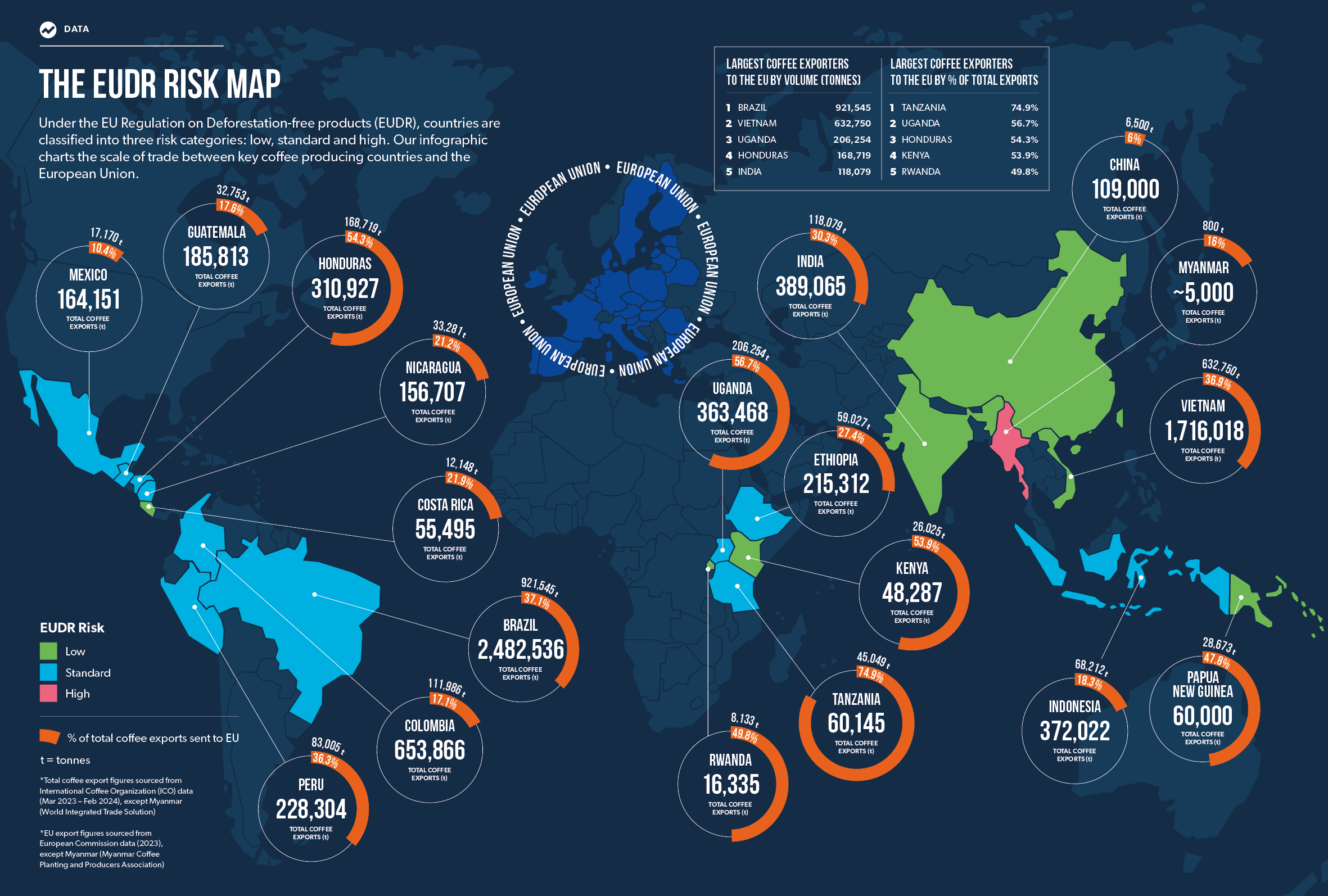
For the global coffee industry, but especially smallholder farmers, the stakes are high. According to the European Commission, the EU accounts for nearly a third of global coffee consumption, importing 2.7 million tonnes of coffee in 2023 from non-EU countries valued at €10.6bn ($2.7bn).
But EUDR has been beset by delays and revisions. Originally due to come into force on 30 December 2024, EUDR was postponed for large companies until 30 December 2025 and for micro and small enterprises until 30 June 2026.
“There is more political opposition at play than there is technical”
– Jon Trask, CEO, Dimitra
In late 2025, EUDR was delayed again following concerns over IT systems. Traces, the European Commission’s online platform for producing EUDR due diligence statements, has suffered ongoing technical issues.
As of March 2026, medium-sized and large operators and traders have until 30 December 2026 to comply. The deadline for smaller operators with revenues of less than €10m is 30 June 2027.
The European Commission is also reviewing ways to simplify reporting and due diligence requirements, a move that has drawn criticism from the Rainforest Alliance and WWF.
Unlock Allegra intelligence for just £1
Already have an account? Sign In